Professional WordPress website
A lightweight business website in accounts owned by the client.
Inclusions and proof
The programme combines a professional WordPress website with industry keyword optimisation and a documented technical handover.
The complete checklist is public below.
 Gentle dental care in Satellite, Ahmedabad.
Every inclusion supports a useful website that the client can control after handover.
A lightweight business website in accounts owned by the client.
A page-to-keyword map and natural optimisation for relevant business searches.
Core pages and actions checked across mobile, tablet and desktop widths.
Indexability, sitemap, canonical, heading, internal-link and metadata checks.
Appropriate business, website and breadcrumb structured data.
Consistent business details, profile connection and local contact actions where relevant.
Google Analytics 4 and Google Search Console connected for the client.
A check report, recorded walkthrough and written editing guide.
Each check records what was tested, why it matters and the evidence used for the result.
What we checkEvery public page loads over HTTPS and returns a successful response.
Why it mattersSearch engines need a secure page they can access.
EvidenceRecorded final URL, protocol and HTTP status.
What we checkIndexable pages have no blocking meta robots or X-Robots-Tag directive.
Why it mattersA hidden noindex directive can remove a page from search.
EvidenceCaptured HTML directive and response header.
What we checkRobots.txt allows search engines to crawl every intended public page.
Why it mattersBlocked pages cannot be crawled reliably.
EvidenceRobots.txt test against representative page URLs.
What we checkThe XML sitemap loads and lists only canonical, indexable pages.
Why it mattersA clean sitemap helps search engines discover important pages.
EvidenceSitemap response, format and URL sample.
What we checkThe sitemap is submitted in the verified Google Search Console property.
Why it mattersSubmission gives Google a direct discovery source.
EvidenceSearch Console submission confirmation.
What we checkEvery indexable page has one correct, absolute canonical URL.
Why it mattersCanonicals tell search engines which URL should represent a page.
EvidenceRendered canonical value for every public page.
What we checkPublic URLs use readable words and a consistent permalink format.
Why it mattersClear URLs help people and search engines understand page purpose.
EvidenceCrawl export of every indexable URL.
What we checkMissing URLs show a useful page and return HTTP 404.
Why it mattersA real 404 prevents missing pages becoming soft errors.
EvidenceResponse and screenshot from a known missing URL.
What we checkEach core page has one clear search topic based on the business and industry.
Why it mattersA page needs a distinct purpose before it can be optimised.
EvidenceApproved page-to-keyword mapping in the handover report.
What we checkSelected terms match the services, audience and locations the client confirms.
Why it mattersRelevant terms connect each page with genuine customer searches.
EvidenceKeyword list and its assigned page.
What we checkEvery indexable page has a unique title aligned with its search topic.
Why it mattersTitles help search engines and searchers identify page relevance.
EvidenceTitle export with duplicates and missing values checked.
What we checkEvery indexable page has a useful and unique search description.
Why it mattersA clear description can improve the search result message.
EvidenceDescription export with duplicates and missing values checked.
What we checkEvery page has one H1 that states its main subject.
Why it mattersA clear H1 gives the page a strong content anchor.
EvidenceRendered H1 count and text for every page.
What we checkSections use H2 and H3 headings in a clear hierarchy.
Why it mattersGood structure makes detailed content easier to understand.
EvidenceHeading outline for every public page.
What we checkThe opening explains the page topic and business relevance in plain language.
Why it mattersPeople and search engines should understand a page quickly.
EvidenceReviewed opening copy for every core page.
What we checkMapped terms appear where useful without repetition or forced wording.
Why it mattersNatural language supports relevance without creating a poor reading experience.
EvidencePage review against its approved keyword map.
What we checkMeaningful images have accurate alt text and decorative images use empty alt text.
Why it mattersCorrect alt text supports accessibility and image understanding.
EvidenceImage and alt text inventory.
What we checkPublic pages contain approved content without placeholders or copied sections.
Why it mattersIncomplete or duplicated content weakens usefulness and trust.
EvidenceFinal content review and duplicate-content check.
What we checkEvery internal link reaches a valid destination.
Why it mattersBroken links stop visitors and crawlers from moving through the site.
EvidenceFull internal link crawl with no unresolved errors.
What we checkExternal links use the intended destination and safe link attributes.
Why it mattersIncorrect external links damage trust and can create security risks.
EvidenceExternal link report and manual review.
What we checkRequired redirects reach the final page in one hop.
Why it mattersRedirect chains slow crawling and create avoidable failure points.
EvidenceRedirect report with status and final destination.
What we checkNavigation and body links connect every important public page.
Why it mattersImportant pages should be easy for visitors and crawlers to find.
EvidenceCrawl depth and internal-link report.
What we checkForms, email, telephone and WhatsApp actions reach the correct destination.
Why it mattersA visible website must still turn interest into a working enquiry.
EvidenceSuccessful test for every published contact action.
What we checkOrganization or the correct LocalBusiness subtype matches visible business details.
Why it mattersStructured data helps search engines resolve the business entity.
EvidenceRendered JSON-LD and validator result.
What we checkWebSite data identifies the site and links it to the business entity.
Why it mattersConnected entities give search engines a consistent site identity.
EvidenceRendered JSON-LD and entity identifiers.
What we checkBreadcrumb data matches the visible navigation path on relevant pages.
Why it mattersBreadcrumbs clarify each page's place in the site.
EvidenceVisible breadcrumb and matching JSON-LD comparison.
What we checkPublished structured data has no validation errors and matches visible content.
Why it mattersInvalid or unsupported markup cannot provide reliable meaning.
EvidenceSchema.org and supported rich-result validation output.
What we checkThe business name, address and phone match across the site and profiles.
Why it mattersConsistent details support local trust and entity matching.
EvidenceSite, schema and Google Business Profile comparison.
What we checkThe profile is claimed, linked and uses the confirmed business categories.
Why it mattersThe profile supports local discovery and connects the website to the business.
EvidenceProfile ownership, category and website-link review.
What we checkThe contact page shows the correct map, hours and local contact actions.
Why it mattersLocal visitors need accurate information before they enquire or visit.
EvidenceContact-page review on mobile and desktop.
What we checkEvery page works at mobile, tablet and desktop widths.
Why it mattersVisitors should complete every task on any common screen.
EvidenceScreenshots and interaction tests at agreed widths.
What we checkThe homepage reaches at least 85 in a recorded mobile Lighthouse lab test.
Why it mattersA responsive layout still needs to load and react quickly.
EvidenceDated mobile Lighthouse report and test conditions.
What we checkThe homepage lab result keeps LCP at or below 2.5 seconds.
Why it mattersLCP measures how quickly the main content becomes visible.
EvidenceRecorded Lighthouse LCP value.
What we checkThe homepage lab result keeps CLS at or below 0.1.
Why it mattersStable pages stop content moving while visitors interact.
EvidenceRecorded Lighthouse CLS value.
What we checkImages use suitable formats, dimensions, compression and loading behaviour.
Why it mattersLarge or unstable images are a common cause of slow pages.
EvidenceImage inventory with size, format and loading attributes.
What we checkThe certificate is valid and the standard security configuration is active.
Why it mattersVisitors and search engines expect a secure connection.
EvidenceCertificate check and security configuration review.
What we checkAutomated backups are scheduled and a restore route is documented.
Why it mattersA usable backup protects the site from avoidable data loss.
EvidenceBackup schedule and restore-location confirmation.
What we checkThe contact form rejects spam and delivers a real test enquiry.
Why it mattersA form only works when the business receives the enquiry.
EvidenceSubmitted test, inbox receipt and spam-control result.
What we checkGA4 receives a verified page view without personal data in event parameters.
Why it mattersReliable measurement helps the owner understand website use.
EvidenceGA4 DebugView or Realtime confirmation.
What we checkThe correct property is verified and accessible to the client.
Why it mattersSearch Console provides indexing and search-performance evidence.
EvidenceProperty verification and client access confirmation.
The report records the launch condition, completed checks and the evidence used for each result.
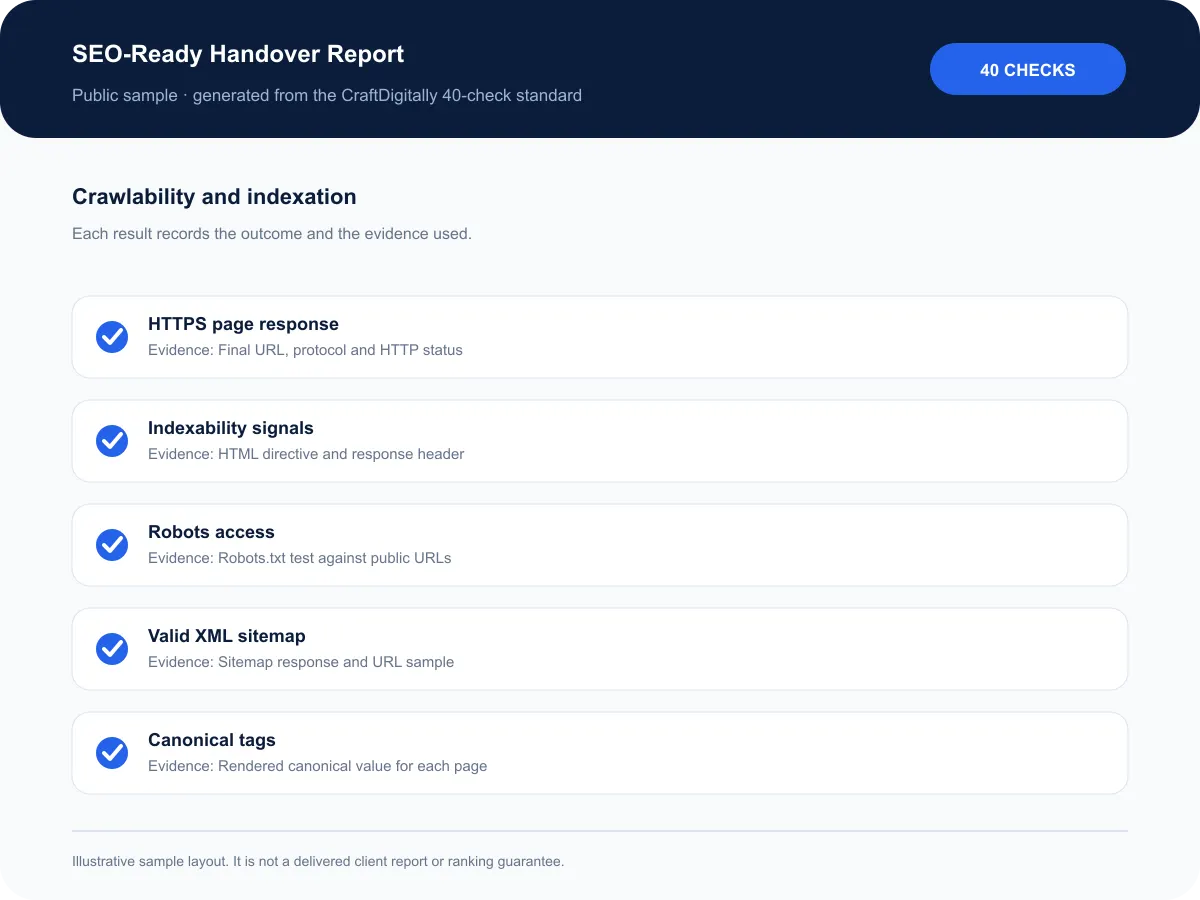
The private report identifies what passed, what evidence was recorded and any action still owned by the client.
The checklist is divided into connected groups so a passing item is not treated as proof of the whole website.
Confirms that intended public pages load securely, allow crawling, use correct canonicals and appear in a valid submitted sitemap.
Confirms that each core page has a distinct topic, useful metadata, one H1, logical headings and natural industry language.
Checks internal and external destinations, redirect paths, page discovery and the contact actions visitors depend on.
Connects visible business details with appropriate schema, profile information, location details and consistent NAP.
Tests responsive layouts, the mobile Lighthouse baseline, LCP, CLS and efficient image delivery under recorded lab conditions.
Confirms secure delivery, backups, a protected working form, Analytics data and client Search Console access.
Each result uses evidence appropriate to the check. A response check records the status and URL, while a structured-data check compares rendered markup with visible page information and validator output.
When a check depends on the client, the handover report identifies the required action. Examples include confirming account ownership, approving business details or completing an external profile step.
The complete result belongs to the client. The public list explains the standard, while the private handover report records the delivered website and its evidence.
Every core page receives one clear search purpose based on the client's services, industry and confirmed locations.
Assign one relevant primary search topic to each core page.
Use the mapped topic naturally in titles, headings, introductions and useful page content.
Review the finished page against the approved map and record the result.
The programme is designed for a focused business website. Complex or ongoing work needs a separate scope.
Hosting referrals are explained in the programme footer and on the Why it is free page.
Need a wider scope? Explore SEO content writing, local SEO or discuss the project.
Tell us about your business. We review every application for fit, scope and current capacity.